



One week your child is gassy. The next, their stools are loose. Then suddenly they struggle to go.
When tummy issues keep cropping up, the better question isn’t only “how do I deal with this today?” but “why does this keep happening?”
In this latest episode of AskMeDoctor!, Dr Ng Yi-Ki, Paediatrician from Baby and Beyond Child Specialist Clinic, discusses the different ways tummy issues show up, what they may tell us about our children’s digestion, and what we can do every day to support a healthier gut.
No time to watch? Here is everything you need to know!
Q1: My child’s tummy issues keep changing: gassy one week, loose stools the next. Are they connected?


Dr Ng Yi-Ki: They can certainly be different ways that tummy issues show up.
A child’s digestive system is affected by many everyday factors: what they’re eating, how much fluid they’re drinking, their activity levels, eating habits and changes in routine.
Medically, we also look for infections and inflammatory bowel diseases.
One occasional episode doesn’t necessarily mean something is wrong.
What’s more useful is looking at what is happening around that episode. You don’t need to analyse everything your child does, but context helps. If they’re suddenly gassy, for example, think about what they’ve eaten, because some foods ferment more in the gut.
We don’t only look at how often a child passes stool.
We also consider stool consistency, whether it’s comfortable to pass, and whether there has been a significant change from that child’s usual pattern.
Knowing your child’s normal is much more useful than comparing them with another child.
Q2: Is being gassy in children, a sign of indigestion?

Dr Ng Yi-Ki: Not necessarily. Gas is a normal part of digestion.
It’s produced as food is broken down in the digestive tract.
Children can also swallow air while eating and drinking, particularly if they rush through their food and chew less, and certain foods may produce more gas.
We need to look at the child as a whole.
Occasional gas in a child who is comfortable, active and otherwise well is very different from gas that happens frequently and causes significant discomfort. It’s worth discussing with a healthcare professional if the gas is:
- persistent
- causing pain
- affecting appetite or activities
- happening together with other symptoms
Q3: My child had a loose stool. Should I be worried?

Dr Ng Yi-Ki: One loose stool doesn’t necessarily mean something is wrong.
Bowel movements can vary occasionally depending on diet, changes in routine or temporary illnesses.
What we want parents to pay attention to is whether it’s happening repeatedly, and how their child is feeling overall.
If it keeps happening, hydration is very important, because children can lose fluids when they pass loose stools frequently and in large volumes.
Look at your child’s overall condition too. Are they drinking? Are they active? Are they behaving normally? Are there other symptoms?
Your child should be assessed by a healthcare professional if there is:
- blood in the stool
- severe abdominal pain
- repeated vomiting
- signs of dehydration
- significant lethargy
- severe or persistent diarrhoea
Q4: When a child is struggling during toilet time, is it just a matter of more fibre, and what should I keep track of?

Dr Ng Yi-Ki: Fibre is important, but it’s only one part of the picture.
Fluid intake matters too, and so do physical activity, routine and toilet habits.
Some children hold their stools because they’re busy playing, don’t feel comfortable using a particular toilet, or have had discomfort passing stool before.
When stool stays in the colon for longer, more water is absorbed from it, which can make it harder to pass.
That’s why we look at all these factors together rather than assuming there’s one cause.
If tummy issues have happened a few times, take note of:
- when the tummy issue happens and how long it lasts
- what your child ate and drank
- any changes in routine
- your child’s appetite, energy, activity and general wellbeing
You can keep these notes on your phone or in a notebook.
If you eventually need to see your child’s doctor, they help us understand what’s been happening.
Try not to make several changes at once or cut out foods straight away, as that can make it harder to work out what contributed to the issue. Children need balanced nutrition for growth, so significant dietary restrictions shouldn’t be made unnecessarily.
If tummy issues keep recurring, it’s better to discuss them with a healthcare professional before making major changes.
Q5: What does a healthy gut actually do, and how can I support it every day?
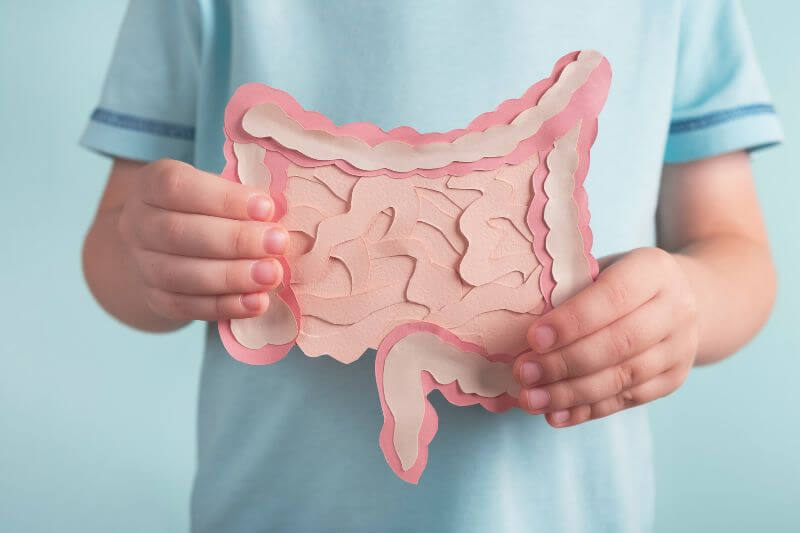
Dr Ng Yi-Ki: A healthy digestive system does quite a lot. It breaks down the food a child eats so nutrients can be absorbed and used by the body, and during childhood that matters because children are constantly growing and developing.
The gut also contains a large community of microorganisms, known as the gut microbiota, which are part of the normal gut environment. The intestinal barrier helps regulate what passes from the gut into the body and plays a role in the body’s natural defence.
Diet influences the gut microbiota, and we can support it in different ways.
Probiotics are live microorganisms that, when provided in adequate amounts, can offer health benefits. Prebiotics are essentially food for the good bacteria living in the gut.
Milk lipids are the fat and fat-like compounds naturally found in milk.
They help support the digestion and absorption of fat-soluble nutrients, and support gut barrier function, which plays a role in the body’s immune defence.
Ultimately, supporting digestive health comes down to consistency:
- a varied and balanced diet with age-appropriate sources of fibre
- enough fluids
- regular physical activity
- good toilet routines
Healthy Tummies Start With Everyday Habits
When it comes to your child’s tummy health, it’s not just about what you do when a tummy issue comes up.
The everyday things matter too, from what they eat and drink to supporting good digestion and a healthy gut environment. That’s also where good nutrition comes in.


The new and improved Friso Gold is a growing-up milk formulated to support digestion and gut immunity** in children aged 1 to 3 years (Step 3) and 3 years and above (Step 4).
It now comes with Milk Lipid Complex (MLC), Pre and Probiotics, helping children experience up to 6x less tummy issues, referring to flatulence, diarrhoea and constipation, in just a week.*
- Milk Lipid Complex (MLC): a natural ingredient derived directly from fresh milk from Friso Gold’s farms. It helps support digestion and the absorption of nutrients such as fatty acids and calcium, and contains nutrients that support gut barrier function and immune defence.
- Pre and Probiotics: help support good gut microbiota and gut immunity.
- 50 essential nutrients: including DHA, AA, Omega 3 & 6, calcium, protein, vitamins and minerals, to support growth and development.
Friso Gold is available at hypermarkets, supermarkets, 99 Speedmart, Manjaku Baby Centre, participating pharmacy chains (CARiNG, BIG Pharmacy, Health Lane Family Pharmacy and Alpro Pharmacy), and Friso Gold official stores on Shopee, Lazada and TikTok Shop.
Reference:
*Up to 6x less tummy issues, referring to flatulence, diarrhoea & constipation, in just a week | Manios et al. BMC Nutrition (2020) | Hageman et al. Dairy J (2019) | Ney L-M et al. Open Biol. (2023)
**Milk Lipid Complex contains nutrients to support gut barrier function & immune defence. | Sheng et al. JNME 2020
Keep up with Motherhood Malaysia between articles. Follow our WhatsApp Channel and Facebook Channel for updates and more parenting content!
Disclaimer: The information provided in this article is for informational purposes only and should not be considered as medical advice from Motherhood. For any health-related concerns, it is advisable to consult with a qualified healthcare professional or medical practitioner.
For more insightful stories and fun recipes, stay tuned to Motherhood Story!