

At a Glance:
A nationwide survey shows a ‘wait‑and‑see’ mindset toward vision health as Malaysia ages, prompting a new public awareness campaign urging earlier eye checks
- While more than 8 in 10 respondents recognise cataracts as an eye condition, 81.7% have never heard of, or remain unsure about, retinal diseases such as age-related macular degeneration (AMD) and diabetic macular oedema (DME)¹.
- Cost of treatment, long waiting times and difficulty scheduling appointments were identified as key barriers to consistent care¹.
- 98% agree that fewer hospital visits would improve their ability to stay consistent with treatment, highlighting the need to consider patient-centred care pathways¹.
A new survey has revealed a major awareness gap in eye health, with more than eight in ten Malaysians unaware of, or unsure about, common sight‑threatening retinal diseases, despite an ageing population and high rates of diabetes.
The findings form the basis of “Don’t Wait to See”, a new public health awareness campaign launched today by the College of Ophthalmologists, Academy of Medicine Malaysia (AMM), Diabetes Malaysia and Bayer Malaysia, calling on Malaysians to recognise vision changes early and make eye health part of routine care.
The commissioned survey of over 800 Malaysian adults across age groups, ethnicities and income levels found that while cataracts are widely recognised, 81.7% of respondents had never heard of or were unsure about retinal diseases such as age‑related macular degeneration (AMD) and diabetic macular oedema (DME), both of which can cause vision loss if not detected early¹.

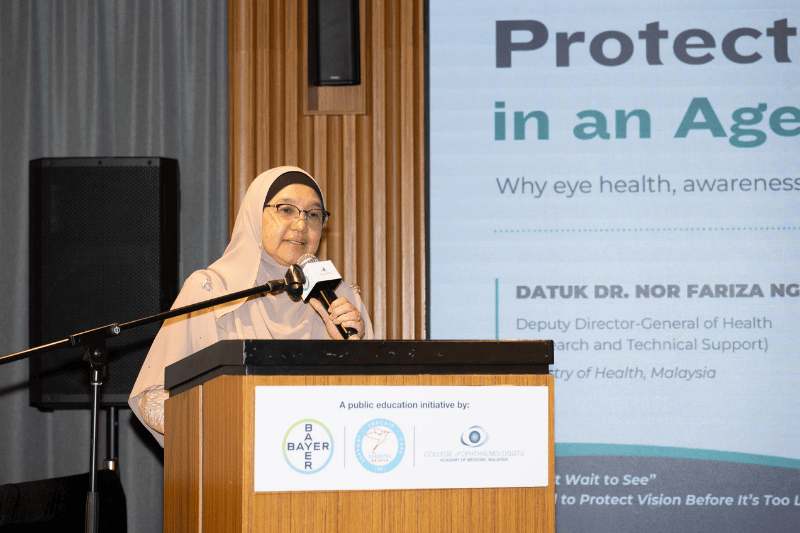
“As Malaysia moves towards becoming an aged nation, with non-communicable diseases such as diabetes continuing to affect many Malaysians, preserving functional independence must be an important public health priority. The findings of this survey remind us that eye health should not be viewed separately from overall health and healthy ageing. Campaigns such as ‘Don’t Wait to See’ play an important role in encouraging Malaysians to recognise changes in their vision earlier, seek timely care and make regular eye examinations part of their routine health care,”
– Datuk Dr Nor Fariza Ngah, Deputy Director-General of Health (Research and Technical Support), Ministry of Health, Malaysia
Echoing the importance of early action, Celest Yong, Head, Focus Brands (Singapore, Malaysia and Indonesia) and Market Access APAC, Bayer Malaysia, said innovation must be matched by awareness, timely diagnosis and patient-centred care.

“Innovation in retinal health is increasingly focused not only on preserving vision, but also on supporting patients’ routines, independence and quality of life. At Bayer, our continued commitment to research and development in retinal health reflects our dedication to innovative solutions that enhance patient outcomes. This progress can only make a difference when people recognise vision changes early and seek the care they need,” said Celest Yong.
Understanding the Warning Signs: Why Painless Changes Still Matter
The survey highlighted a gap between how Malaysians perceive eye health and how retinal conditions may present. When straight lines begin to appear wavy or distorted, nearly half of all respondents, 48.4%, attributed it to eye strain or a natural part of ageing. Only 8% identified it as a possible medical condition¹.
The findings also suggest that many Malaysians may associate pain with urgency. More than 81.8% of respondents said they would wait weeks, months or indefinitely before seeking care if a change in vision was not physically painful¹.
However, retinal diseases such as wet age-related macular degeneration (wet AMD) and diabetic macular oedema (DME) can develop without pain in the early stages³,⁴. This makes it important for sudden or unusual changes in central vision to be assessed in a timely manner.

“Conditions such as diabetic macular oedema and wet age-related macular degeneration may develop without pain, which is why changes in central vision should not be dismissed. If straight lines appear wavy or distorted, or if vision changes suddenly, it is important to seek timely specialist assessment. Early attention can help patients better understand what is happening and receive appropriate care,”
– Dr Rajasudha Sawri Rajan, Consultant Ophthalmologist and Medical Retina Specialist, Vice Chairperson of Retina Chapter (College of Ophthalmologists)
Dr Tara George, Consultant Ophthalmologist and Medical Retina Specialist, noted that for people living with diabetes, the issue is not only recognising vision changes but also understanding that eye health is part of diabetes care.

“For people living with diabetes, eye care needs to be part of routine disease management, not something addressed only when vision has already changed. The good news is that treatment options for retinal conditions such as diabetic macular oedema have evolved significantly.
Today, we have effective therapies that can help stabilise vision and, in some cases, support meaningful improvement when patients present early.
This underscores the importance of regular retinal checks, at least once a year for people with diabetes, so that if changes are detected, there is the opportunity to act at a stage where treatment can make the greatest difference,” said Dr Tara George, Consultant Ophthalmologist and Medical Retina Specialist.
The Diabetic Disconnect: Eyes Left Out of the Equation
The awareness gap is particularly important among people living with diabetes. According to NHMS 2025, 39% of older Malaysians have diabetes, and among those with a known diagnosis, one in two have uncontrolled blood sugar².
In the “Don’t Wait to See” survey, more than half of respondents said they had either been diagnosed with diabetes or were unsure of their diabetes status, yet awareness of diabetic macular oedema (DME) remained low at 8.9%¹.
The survey also found that eye examinations ranked last among health screening priorities, behind blood pressure, blood sugar, cholesterol and cancer screening¹. This suggests that eye health may not yet be seen as part of routine diabetes care, even though diabetes can affect the retina and lead to changes in vision if not detected and managed early⁵.
“Diabetes care is often focused on blood sugar, blood pressure and cholesterol, but eye health needs to be part of the same conversation. For people living with diabetes, regular comprehensive eye examinations are an important part of long-term care. We need to help patients understand that protecting their eyes is part of managing diabetes well,”
– Dr Mohazmi bin Mohamed, Honorary General Secretary of Diabetes Malaysia and Primary Care Specialist
The survey findings show that Malaysians recognise the role of vision in daily independence. 90% of respondents agreed that maintaining good vision is essential to ageing independently.
When asked about their greatest quality-of-life concerns, 40% cited losing the ability to drive, followed by the ability to read or use a smartphone, 35.5%, and the possibility of losing employment, 13%¹.
These findings reflect how closely vision is connected to everyday routines, work, mobility and family life. NHMS 2025 provides further context, reporting that one in four older Malaysians has limitations in performing instrumental daily activities such as using the telephone, managing medications, handling finances and preparing food.²
As many of these activities depend on clear vision, retinal health should be seen not only as an eye health issue but also as part of healthy ageing, independence and quality of life.
Removing the Barriers: What Patients Say Would Help

For those who seek care, the survey identified practical barriers that may affect their ability to stay consistent with appointments and treatment. Cost of treatment was cited as the biggest obstacle, 75%, followed by long waiting times, 64%, and difficulty scheduling appointments, 55%¹.
The survey also found that treatment visit frequency can affect daily routines.
More than eight in ten respondents, 82.9%, said current treatment visit frequencies were disruptive to their daily lives, while 83.8% preferred follow-up appointments every six months or at longer intervals. Nearly all respondents, 98%, agreed that fewer hospital visits would improve their ability to stay consistent with care¹.
These findings suggest that improving retinal care is not only about awareness but also about making care pathways easier for patients to understand and maintain over time.
NHMS 2025 also found that one in three carers of dependent older persons experience physical, emotional or financial burden².
In this context, timely detection, regular follow-up and more accessible eye care pathways may help support not only patients, but also the families and carers who care for them.
“For many people living with diabetes, staying consistent with care is not simply about willingness. Cost, waiting time, appointment availability and the burden of managing multiple health needs can all affect follow-through. This is why eye care must be better integrated into diabetes care, with clearer reminders, simpler referral pathways and practical support for regular follow-up. When the care journey is easier to maintain, patients are better supported in protecting their vision over time,” added Dr Mohazmi bin Mohamed, Honorary General Secretary of Diabetes Malaysia and Primary Care Specialist.
The “Don’t Wait to See” campaign carries a dual message: for the public, do not wait for vision changes to worsen before seeking advice; and for healthcare professionals, make eye health part of routine conversations with patients, especially those aged 40 and above or living with diabetes.
The coalition encourages Malaysians to consult their doctor, primary care physician or eye care professional if they notice changes such as blurred, wavy or distorted vision.
Malaysians aged 40 and above and people living with diabetes are also encouraged to ask their healthcare professional about regular comprehensive eye examinations as part of routine care.
When detected and managed in a timely manner, retinal conditions may have treatment options that can help patients better manage their condition and support their quality of life.
Recognising changes earlier and seeking timely advice can help Malaysians take a more proactive role in caring for their eye health as they age.
About the Survey:
The “Don’t Wait to See” Eye Health Awareness Survey was a web-based questionnaire conducted between 3 April and 20 April 2026. It polled 802 respondents drawn from Malaysian adults across multiple age groups, ethnicities and income levels, with the majority falling within the 41 to 60 age bracket. The survey was commissioned to understand Malaysians’ habits, perceptions and awareness relating to eye health and retinal conditions.
Additional data cited in this release is sourced from the National Health and Morbidity Survey (NHMS) 2025: Older Persons Health, published by the Institute for Public Health, National Institutes of Health, Ministry of Health Malaysia (MOH/S/IKU/269.26(IL)-e). The full report is available at https://iku.nih.gov.my/nhms2025.
References:
- “Don’t Wait to See” Eye Health Awareness Survey. Web-based questionnaire conducted 3–20 April 2026. n=802 Malaysian adults across multiple age groups, ethnicities and income levels. Data on file. Accessed on 5 May 2026.
- Ministry of Health Malaysia: Institute for Public Health. National Health and Morbidity Survey (NHMS) 2025: Older Persons Health. (MOH/S/IKU/269.26(IL)-e). Retrieved from: https://iku.nih.gov.my/nhms2025. Accessed on 5 May 2026.
- American Diabetes Association. Diabetes-Related Macular Edema. Retrieved from: https://diabetes.org/health-wellness/eye-health/diabetes-related-macular-edema. Accessed on 5 May 2026.
- Macular Society. Diabetic Macular Oedema. Retrieved from: https://www.macularsociety.org/macular-disease/macular-conditions/diabetic-macular-oedema/. Accessed on 5 May 2026.
- National Eye Institute, National Institutes of Health. Diabetic Retinopathy. Retrieved from: https://www.nei.nih.gov/eye-health-information/eye-conditions-and-diseases/diabetic-retinopathy. Accessed on 5 May 2026.
- Ministry of Health Malaysia. Clinical Practice Guidelines: Screening of Diabetic Retinopathy. Putrajaya: MOH; 2017. Retrieved from: https://www.moh.gov.my/images/04-penerbitan/rujukan/penyakit-berjangkit/diabetes/Diabetic_Retinopathy_Screening_Module.pdf. Accessed on 5 May 2026.
Disclaimer: The information provided in this article is for informational purposes only and should not be considered as medical advice from Motherhood. For any health-related concerns, it is advisable to consult with a qualified healthcare professional or medical practitioner.
For more insightful stories and fun recipes, stay tuned to Motherhood Story!