


Malaysia’s education system is preparing for several major changes, and parents with school-going children or little ones approaching school age will want to understand what is coming.
From a new school curriculum and changes to classroom learning to an earlier Year 1 entry option and plans to make secondary education compulsory, these developments could affect how children learn and progress through school.
But what exactly is changing? Will children have fewer subjects? Does every child need to start Year 1 at six? And will students be required to continue schooling beyond primary education?
Here are three important education developments parents should know about ahead of the 2027 school year, based on official announcements and documents from the Ministry of Education Malaysia (KPM).
1. A New School Curriculum Will Be Introduced in 2027
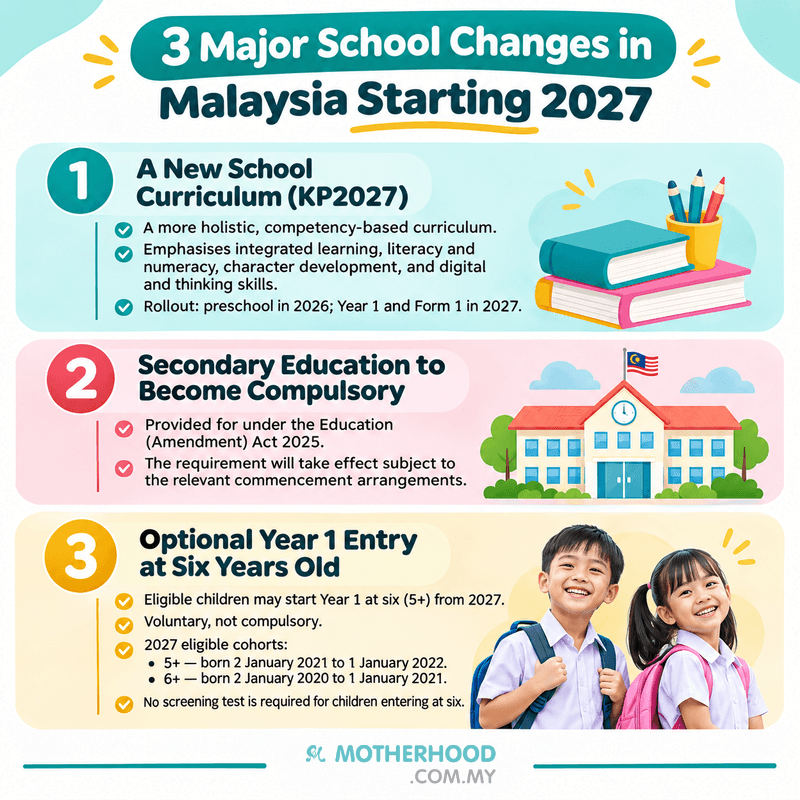
One of the biggest developments is the introduction of the Kurikulum Persekolahan 2027 (KP2027), or the 2027 School Curriculum.
According to the Ministry of Education’s official KP2027 curriculum framework, the new curriculum aims to provide a more holistic and competency-based learning experience.
It combines standards-based and competency-orientated approaches, allowing children to develop knowledge, practical skills and positive values through meaningful learning experiences.
The implementation is being introduced progressively, with the new preschool curriculum beginning in 2026, followed by Year 1 and Form 1 in 2027.
What Will Change in the Classroom?
Under KP2027, learning will place greater emphasis on developing children’s overall abilities rather than focusing solely on academic knowledge.
Some of the key approaches include:
-
Integrated Learning: Primary school pupils will experience integrated learning classes, where content and skills from different disciplines are connected to create more meaningful learning experiences.
-
Stronger Literacy and Numeracy: The curriculum will emphasise mastery of basic reading, writing and arithmetic (3M), with early intervention for children who need additional support.
-
Character Development: Social-emotional learning, positive values, communication and responsible behaviour will form part of children’s development throughout their schooling.
-
Digital and Thinking Skills: The curriculum framework also highlights digital fluency, multiple literacies, communication, responsibility and critical thinking.
The objective is to help children become more confident, adaptable and capable of applying what they learn in real-life situations.
For parents, this means the new curriculum is not simply about changing school subjects. It also involves changing how children learn, develop and apply their knowledge.
2. Secondary Education Is Set to Become Compulsory
Another significant development concerns the extension of compulsory education beyond primary school.
Under the Education Act 1996, compulsory education has traditionally focused on primary schooling. However, the government has taken steps to extend this requirement to secondary education through the Education (Amendment) Act 2025.
The amendment was passed by Parliament, received Royal Assent on 15 October 2025 and was published in the Federal Gazette on 28 October 2025.
According to the official Education (Amendment) Act 2025, Act A1770, the amendment provides for a new Section 32A concerning compulsory secondary education.
What Does This Mean for Parents?
Under the new provision, parents whose children are Malaysian citizens residing in Malaysia will be required to ensure that their children enrol in and remain in an educational institution for secondary education once the relevant requirements take effect.
The broader objective is to ensure that more Malaysian children continue their education beyond primary school, reducing school dropout rates and giving them greater opportunities to develop the knowledge and skills they need for the future.
However, there is an important distinction parents should understand.
Although the Education (Amendment) Act 2025 has been enacted, Section 1 states that it will come into operation on a date appointed by the Minister through a notification in the Federal Gazette.
Section 32A also provides for secondary education to be prescribed as compulsory through a ministerial order published in the Gazette.
This means parents should not assume that compulsory secondary education automatically takes effect at the beginning of the 2027 school year. The applicable commencement date and implementation requirements should be checked against subsequent official announcements.
3. Children Can Start Year 1 at Six Years Old From 2027
Perhaps one of the most widely discussed changes is the option for children to enter Year 1 at six years old (5+) beginning in 2027.
Under the existing arrangement, children generally enter Year 1 at seven years old. However, the government is introducing an earlier entry option to provide greater flexibility for families.
Importantly, starting Year 1 at six is voluntary, not compulsory.
Parents can decide whether their child is ready to begin formal primary education at the earlier age or whether they would benefit from starting at seven.
According to KPM’s official Year 1 registration announcement for the 2027 academic calendar, registration was opened to two age cohorts.
Who Is Eligible for Year 1 Entry in 2027?
For the 2027 school year, the eligible cohorts for Malaysian citizens are:
-
Six-year-old cohort (5+): Children born between 2 January 2021 and 1 January 2022.
-
Seven-year-old cohort (6+): Children born between 2 January 2020 and 1 January 2021.
Both cohorts are eligible to apply for Year 1 entry in 2027, subject to the applicable registration and placement requirements.
KPM also confirmed that children entering at six under this voluntary arrangement do not need to sit for a screening test.
Can Parents Still Register Their Children After the Deadline?
The online registration period for Malaysian children entering Year 1 in 2027 ran from 15 February to 31 March 2026 through the MOE Integrated System (MOEIS).
However, parents who missed the registration deadline may still approach the nearest District Education Office (PPD) or State Education Department (JPN) to enquire about submitting an application after the closing date.
This arrangement is stated in KPM’s official Year 1 registration FAQ, updated in October 2026.
Parents should contact the relevant education office directly for guidance on the application process and available placement options.
Should Parents Send Their Children to School at Six?
Although the earlier entry option gives parents more flexibility, it does not necessarily mean every child should start school as soon as they become eligible.
School readiness involves more than knowing how to read, write or count.
Parents should also consider their child’s:
-
Emotional Readiness: Can they manage separation from their parents, cope with new situations and regulate their emotions?
-
Social Development: Are they comfortable interacting with other children, sharing and participating in group activities?
-
Communication Skills: Can they express their needs, understand instructions and communicate with teachers?
-
Independence: Can they manage basic daily routines, such as eating, using the toilet and looking after their belongings?
-
Learning Readiness: Can they pay attention, follow simple instructions and participate in age-appropriate learning activities?
Every child develops at a different pace. Some may be comfortable entering formal schooling earlier, while others may benefit from having another year to develop their confidence and independence.
Parents should therefore consider their child’s overall development before deciding which entry route is more suitable.
What Should Parents Do Before the 2027 School Year?
With these changes approaching, parents can start preparing by understanding the new arrangements and keeping track of official announcements from the Ministry of Education.

Here are a few practical steps:
-
Understand the New Curriculum: Familiarise yourself with the changes under KP2027, especially if your child will be entering Year 1 or Form 1.
-
Check Your Child’s School Entry Eligibility: Confirm which age cohort your child belongs to and the applicable registration and placement requirements.
-
Assess Your Child’s School Readiness: Consider their emotional, social, physical and learning development before choosing the earlier Year 1 entry option.
-
Stay Updated on Education Policies: Follow announcements from KPM and your child’s school for further information about curriculum implementation and compulsory education requirements.
Parents who have already registered their children can check their placement information through MOEIS. Those who missed registration should contact their nearest PPD or JPN for further assistance.
What These Changes Mean for the Future of Malaysian Children
Malaysia’s education developments represent a significant shift in how children will enter, experience and progress through the national school system.
The introduction of KP2027 aims to provide a more integrated learning experience, while the Education (Amendment) Act 2025 establishes a legal framework for extending compulsory education to secondary school.
Meanwhile, the voluntary early Year 1 entry option gives parents more flexibility to decide when their children are ready to begin formal schooling.
For parents, the most important thing is to understand that these developments are not just about starting school earlier or changing the curriculum. They are part of a broader effort to shape children’s educational experiences and prepare them for the future.
As implementation approaches, staying informed and understanding your child’s individual needs will help you make more confident decisions about their education.
Remember, every child develops differently, and the best school entry decision should take your child’s readiness and well-being into consideration.
Stay Connected with Motherhood!
Get helpful parenting tips, expert advice, pregnancy updates, family news and more, delivered straight to your WhatsApp.
Join our community and stay informed throughout your parenting journey. Follow Motherhood’s WhatsApp Channel and Facebook Channel now!
Disclaimer: The information provided in this article is for informational purposes only and should not be considered as medical advice from Motherhood. For any health-related concerns, it is advisable to consult with a qualified healthcare professional or medical practitioner.
For more insightful stories and fun recipes, stay tuned to Motherhood Story!
