


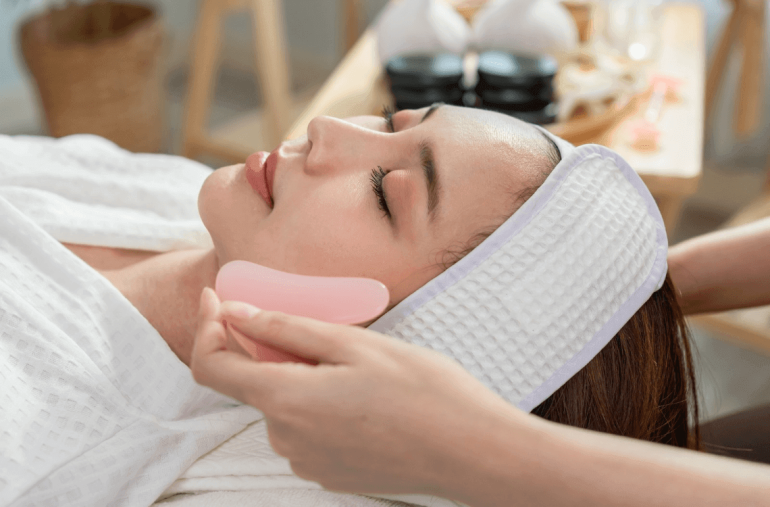
I feel you, mummies. Some mornings, we catch our reflection and think, “Why does my face look so puffy today?”
Maybe it’s after a broken night’s sleep or one of those mornings when we’re getting everyone ready and barely have time to look in the mirror.
So when gua sha pops up in our skincare feeds, it’s natural to wonder: does it actually do anything?
In this AskMeDoctor! episode, we chatted with G.M.P. Tan Jing Yi about how gua sha is used in Traditional Chinese Medicine (TCM)—and what it’s meant to do for the face.

Tan explains that, in TCM, gua sha is used to encourage the flow of Qi through the body’s meridians and support the circulation of Qi and blood. She describes Qi as the “air inside our body”. For the face, she says, gua sha may also help relax the muscles.
That’s the TCM way of understanding the practice. And as my fellow mums can attest, we’re always curious about what might help us feel a little more refreshed—but it’s good to keep expectations realistic. Research on facial gua sha is still limited, so think gentle massage, not a guaranteed face-lifting fix. A 2025 systematic review found there isn’t enough evidence to confidently establish the effects of mechanical facial techniques.
Could It Help with a Puffy Face?
If you’ve ever looked in the mirror and thought, “Why is my face so puffy today?”, you’re definitely not alone. Tan says facial massage may help when puffiness is related to fluid retention or poor circulation.
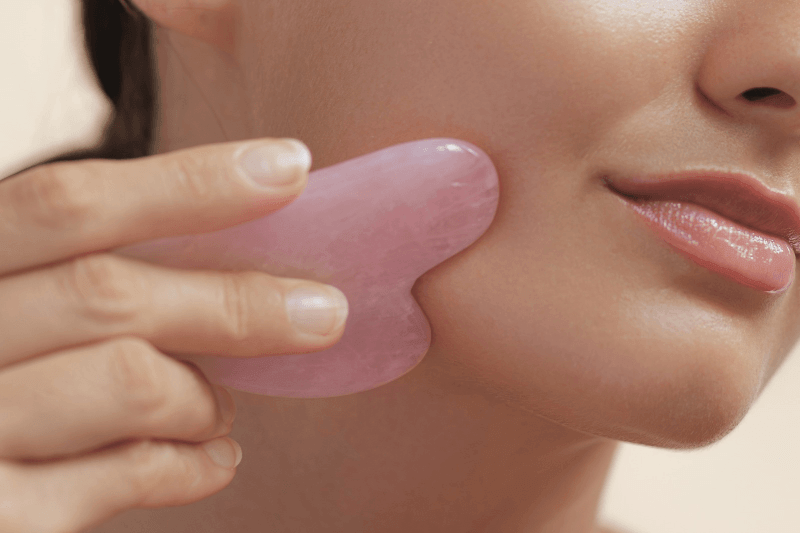
She also explains that in TCM, facial puffiness may be linked to spleen dysfunction and dampness, which can cause fluid to collect around the face.
That’s the TCM explanation she shares; it doesn’t mean every puffy face has the same cause. Research hasn’t confirmed facial gua sha as a treatment for puffiness either. Cleveland Clinic notes that research hasn’t directly looked at whether facial gua sha reduces it.
It’s Not Just for the Face
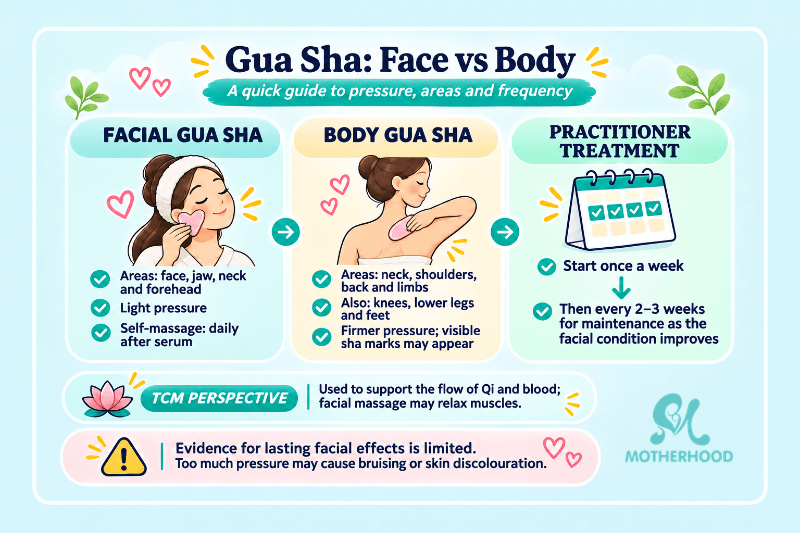
Most of us probably first heard about gua sha as a skincare step, but Tan says it can be used on other parts of the body too. Facial gua sha may cover the face, jaw, neck and forehead. Body gua sha can be done on the neck, shoulders and back, as well as larger areas of the limbs. It can even be used around the knees, lower legs and feet.
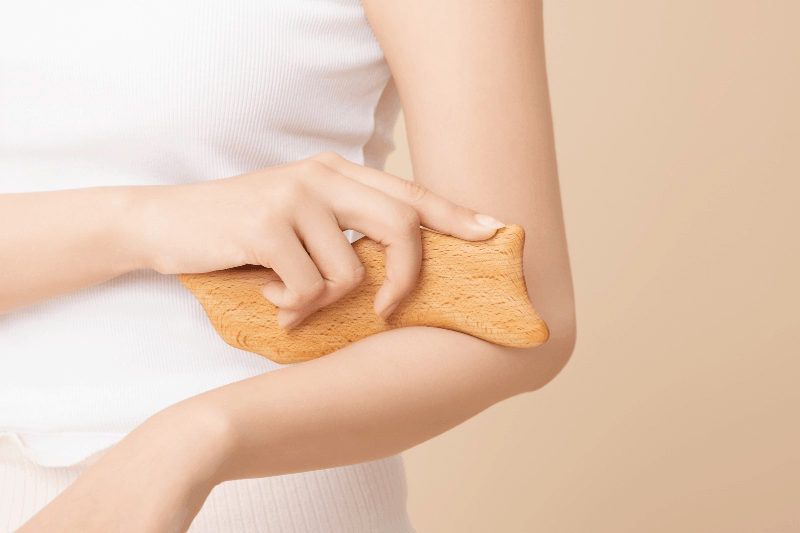
The pressure is different depending on the area. Tan says facial gua sha uses a lighter touch, while body gua sha uses firmer pressure to promote circulation and relax muscles. That stronger pressure can bring out sha—the visible marks associated with body gua sha.
Facial gua sha shouldn’t automatically be assumed to be bruise-free, though. Too much pressure can still cause bruising or skin discolouration. Cleveland Clinic recommends a gentle touch on the face and notes that aggressive scraping can cause bruising. Its gua sha guide has more on technique and safety.
How Often Can You Use It?
For gentle self-massage, Tan says gua sha can be done daily after applying serum. If you’re having it done by a practitioner, she recommends starting once a week. When your facial condition improves, she suggests spacing sessions out to once every two to three weeks for maintenance.
A Gentle Ritual with Realistic Expectations
For mums who enjoy a little skincare moment amid the rush of the day, gentle gua sha can be a relaxing part of a routine.
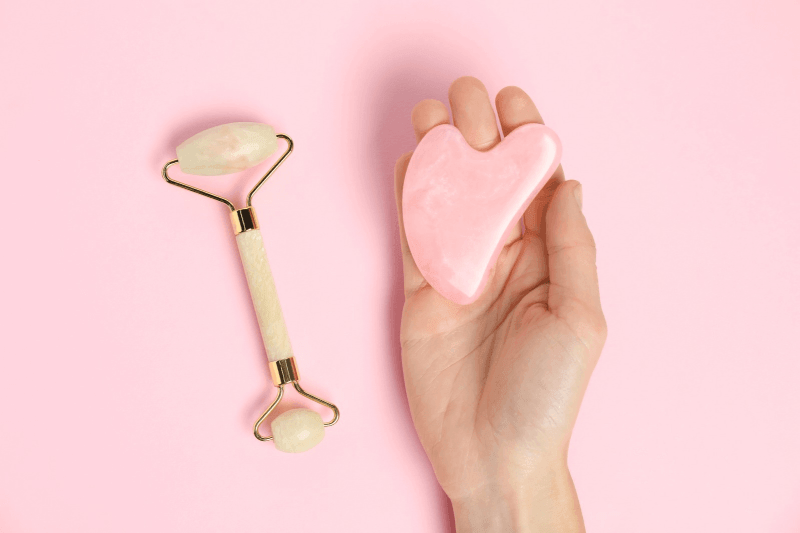
Tan Jing Yi explains its benefits from a TCM perspective, while research on lasting effects is still limited. Her practical advice is to keep facial strokes gentle, use serum, and follow a practitioner’s guidance for in-person treatments. Enjoy the massage for what it is, without expecting it to transform your face overnight.
Curious about more everyday health and wellness questions? Follow AskMeDoctor! on Instagram for more expert conversations.
Stay Connected with Motherhood!
Get helpful parenting tips, expert advice, pregnancy updates, family news and more, delivered straight to your WhatsApp.

Join our community and stay informed throughout your parenting journey. Follow Motherhood’s WhatsApp Channel and Facebook Channel now!
Disclaimer: The information provided in this article is for informational purposes only and should not be considered as medical advice from Motherhood. For any health-related concerns, it is advisable to consult with a qualified healthcare professional or medical practitioner.
For more insightful stories and fun recipes, stay tuned to Motherhood Story!
