I never imagined I would be the parent considering homeschooling.
Like many families, we are currently following the conventional route – Sekolah Kebangsaan. We trust the system, adjust expectations and tell ourselves that children adapt.
But, recently, that belief has become harder to hold.
We are seeing more reports of younger children lashing out, struggling with emotional regulation, and displaying short tempers far earlier than expected.
At the same time, policy announcements feel rushed and incomplete.
For instance, the proposal to allow six-year-olds into Year One came with limited detail on execution, facilities, learning structure, or how schools will realistically cope with an even younger intake.
Then came the moment that made me question my decisions as a parent.
During his second week of Year One, my son came home quiet.
When I asked how school felt, he said, “I feel like an overflowing cup stuck in a box.”
He explained that they must sit in one place for long periods. That the television is on frequently during school hours, which makes him unsure whether watching TV at home is still okay.
That more often than not the toilet has no water and isn’t child-friendly (just very dirty and stinky).
That he feels restless but cannot move.
None of this is dramatic on its own – kids are kids after all. However, together, it points to a child who is overstimulated, under-supported, and overwhelmed.
What I find most difficult to accept is the idea that children must suffer to become resilient.
That hardship automatically builds gratitude. That emotional discomfort is simply part of growing up.
That belief feels intolerable now.
With the possibility of six-year-olds entering Year One in larger numbers, we also have to ask honestly whether our schools are ready or whether we are stretching an already strained system beyond its capacity.
This is where homeschooling entered the conversation for our family.
Is Homeschooling Legal in Malaysia?
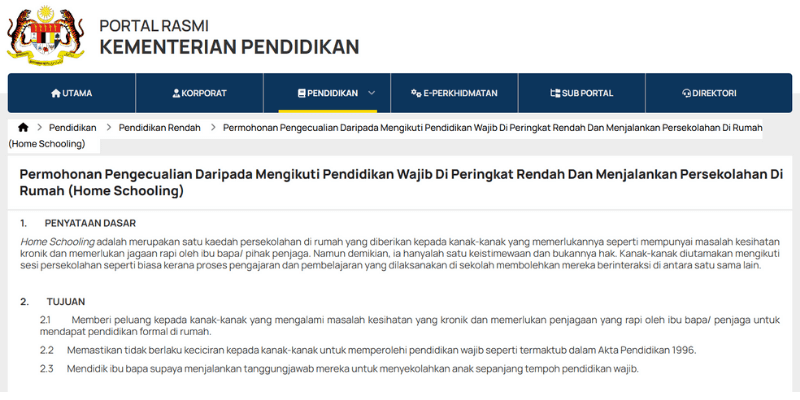
Yes, homeschooling is legal in Malaysia, but it is not automatic.
Under the Education Act 1996, primary education is compulsory.
However, parents may apply for an exemption from compulsory school attendance if they intend to homeschool their child.
Homeschooling is therefore treated as a conditional alternative, not a default right. Approval is typically assessed on a case-by-case basis.
Who Oversees Homeschooling in Malaysia?

Homeschooling applications are handled through the Ministry of Education Malaysia, usually via the State Education Department (Jabatan Pendidikan Negeri) where the family resides.
Parents are expected to demonstrate that:
-
The child will still receive structured education
-
The home environment is conducive to learning
-
There is a clear plan for curriculum and supervision
How Do Parents Apply to Homeschool in Malaysia?
This is the part many parents struggle to find clear information on.
Step 1: Prepare a Formal Application
Parents must submit a written request for exemption from compulsory schooling to their State Education Department. While there is no single public template, applications usually include:
-
Child’s full name, MyKid/MyKad number, and age
-
Parents’ details and contact information
-
Reason for homeschooling (health, emotional wellbeing, learning needs, family circumstances, etc.)
Step 2: Outline the Learning Plan
Parents are often asked to explain:
-
What curriculum will be used (national, international, or structured alternative)
-
How learning will be delivered (home tutor, online programme, centre-based homeschooling)
-
Daily or weekly learning structure
-
Who will supervise learning
Step 3: Demonstrate Home Readiness
Some sources indicate that the Ministry may:
-
Assess whether at least one parent is available to supervise learning
-
Request proof of a suitable learning space at home
-
In some cases, conduct a home visit or follow-up interview
Step 4: Await Approval (Not Guaranteed)
Approval is NOT GUARANTEED and historically has been granted more readily for:
-
Children with medical or developmental needs
-
Families with frequent relocation or travel
-
Exceptional circumstances
This uncertainty is one reason many parents choose online programmes or registered homeschooling centres, which already operate within established frameworks.
What Homeschooling Options Do Malaysian Families Have?

Homeschooling today is far more diverse than many assume.
1. One-to-One Homeschooling at Home
Parents hire a qualified teacher or tutor who teaches the child at home, often following an international or customised curriculum. This allows:
-
Personalised pacing
-
Reduced sensory overload
-
Greater flexibility
2. Online Homeschooling With Small Groups
Children attend live online classes with a small cohort. These programmes usually offer:
-
Structured schedules
-
Peer interaction
-
Academic tracking
3. Face-to-Face Homeschooling Centres
These operate like micro-schools with small class sizes.
Children attend physically but in less rigid environments, often with shorter hours and alternative teaching methods.
Each option differs in cost, structure, and parental involvement.
What Curriculum Do Homeschoolers Follow?
There is no single mandated curriculum, but parents are encouraged to choose structured programmes. Common options include:
-
International curricula (IGCSE-based, Australian, UK)
-
Customised learning plans with documentation
-
Hybrid approaches combining online and hands-on learning
Many experienced homeschoolers maintain learning portfolios that track progress, projects, assessments, and skills, which are especially useful if interacting with authorities or planning future academic pathways.
Will Homeschooled Children Become Antisocial?

This is one of the most common concerns and one of the most misunderstood.
Malaysia has a growing homeschooling community and parent networks that organise:
-
Group classes
-
Sports and enrichment activities
-
Field trips and learning outings
Homeschooled children often socialise across age groups rather than being limited to same-age peers.
Families can also plan school-like excursions and collaborative learning sessions similar to conventional schools.
Socialisation still happens; they just experience it differently.
Can Parents Realistically Cope With Homeschooling?

Homeschooling does require greater parental presence.
For online programmes or one-to-one home teaching, having a stay-at-home parent, or a parent with flexible or remote work arrangements is often beneficial.
Parents are not expected to teach everything themselves, but they do need to be involved in scheduling, emotional support, and oversight.
Homeschooling is not a permanent or all-or-nothing decision.
Some families try it temporarily. Others reassess annually. What matters is choosing what supports both the child and the family.
What About Exams, Certification, and University Later On?

Homeschooled children in Malaysia can still:
-
Sit for international examinations such as IGCSE
-
Apply to universities that accept homeschool transcripts and exam results
Long-term planning is key, which is why many families choose recognised programmes or maintain clear academic documentation from early on.
All in all, homeschooling, for us, is not about rejecting public schools or claiming one path is superior to the other.
It is about listening when a child says he feels like an overflowing cup trapped in a box.
It is also about questioning whether resilience truly comes from endurance alone or whether it grows better in environments where children feel safe, supported, and seen.
I don’t have a final answer yet, and we’re still figuring it out but sometimes the beginning of brighter future for our kids starts with the road less taken.
Wish us luck, my fellow mummies!
Disclaimer: The information provided in this article is for informational purposes only and should not be considered as medical advice from Motherhood. For any health-related concerns, it is advisable to consult with a qualified healthcare professional or medical practitioner.
For more insightful stories and fun recipes, stay tuned to Motherhood Story!